Coffee T-shirt Design 25: Print Templates & Graphics for Local Branding
As a brand designer who’s helped over 70 local businesses—from neighborhood coffee roasters to handmade soap studios—build cohesive, shelf-ready identities, I approached Coffee T-shirt Design 25 with one question: *Does this graphic design asset translate beyond apparel into real-world small business branding?*
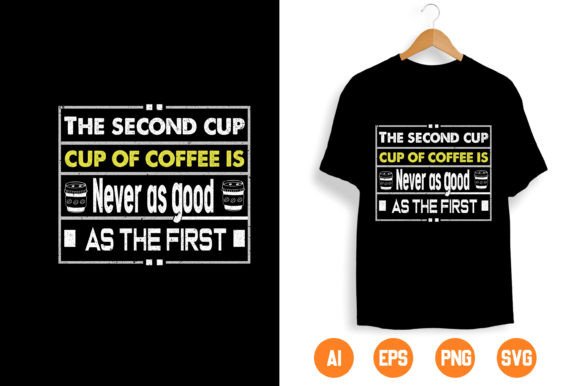
My first impression? Warm, gently self-aware, and quietly confident. The phrase *“The second cup of coffee is never as good as the first”* lands with a knowing smile—not irony, not sarcasm, but the kind of relatable warmth that fits perfectly in a sunlit bakery window or on a ceramic mug beside a locally roasted bean bag. It leans into organic authenticity without leaning too hard on rustic clichés. Think soft contrast, balanced negative space, and subtle typographic rhythm—not bold streetwear energy, but thoughtful modern design with handmade soul.
This mood makes Coffee T-shirt Design 25 ideal for food businesses, boutique retailers, and creative entrepreneurs who value approachability over austerity. It reads as premium-adjacent—not luxury minimalist, but warmly professional. That nuance matters when you’re designing for a seasonal candle brand launching autumn blends, a florist adding branded thank-you cards to bouquets, or a children’s product line needing playful yet polished packaging accents.
In practice, Coffee T-shirt Design 25 shines across multiple touchpoints. As a core element of logo design, it works best when paired with a clean wordmark—say, “Hearth & Grind Coffee Co.”—to anchor the wit in credibility. For packaging design, it elevates simple kraft bags, glass jars, and compostable mailers: use it as a die-cut window accent on tea boxes, a foil-stamped detail on soap labels, or a repeating pattern on sticker sheets for jar seals. On product labels, it adds narrative texture without overwhelming ingredient lists—especially when scaled down thoughtfully.
It also strengthens visual hierarchy in marketing visuals. When placed above a product mockup on Instagram, it creates instant emotional resonance before the eye lands on the CTA. On printed flyers or seasonal posters, it functions as a hero graphic that draws attention while reinforcing brand voice. And because its phrasing carries universal recognition, it performs well in editorial design contexts—think printable inserts for subscription boxes, café menu headers, or limited-edition holiday packaging.
Where does it deliver measurable business value? First, in stronger first impressions: customers remember brands that speak with personality—and this phrase sticks. Second, in better product recognition: repeated, consistent use across hang tags, stickers, and social media builds subconscious familiarity. Third, in improved customer trust: the tone signals authenticity and care—qualities small business buyers actively seek. Fourth, in more polished marketing visuals: whether adapted for Canva templates or custom web design, it elevates otherwise generic layouts into intentional brand moments.
Coffee T-shirt Design 25 works best where charm and clarity coexist: product labels (especially front-of-pack), packaging accents (like belly bands or ribbon seals), hero graphics for website banners, decorative elements on thank-you cards, seasonal campaign visuals (e.g., “First Sip” spring launch), boutique visuals (window clings, tote bag prints), and social media graphics where tone matters as much as aesthetics.
Use it carefully in formal corporate branding—its conversational voice may feel out of place next to legal disclaimers or investor-facing materials. Avoid cramming it onto very small labels (<1.5” width) where legibility suffers, or layering it over busy backgrounds where contrast collapses. It shouldn’t compete with essential information: keep it away from ingredient-heavy layouts, regulatory text zones, or low-contrast surfaces like light gray on beige. And if your brand identity leans into luxury minimalism—think monochrome serif typography and uncoated paper stock—this design’s warmth may dilute your precision-focused positioning.
Here are my practical brand designer notes before deploying Coffee T-shirt Design 25 in client work:
- Test it on real packaging mockups—not just digital previews—to assess scale, spacing, and print fidelity.
- Check black-and-white usage: does the phrase retain impact when converted to grayscale for spot-ink printing or thermal labels?
- Preview it on small labels at actual size—especially if used for jar seals or tea tags.
- Test it alongside your brand colors: does it harmonize with warm terracotta, muted sage, or deep navy—or does it need subtle color adjustment?
- Compare it against competitor packaging: does it stand out on shelf while still feeling category-appropriate?
- Verify print quality: request high-res PNG and vector SVG files—inspect transparency edges and scalability.
- Confirm commercial licensing: ensure it permits physical product sales, client deliverables, and promotional distribution—not just personal use.
- Test font pairings: try it beside serif (e.g., Playfair Display), sans serif (e.g., Inter), script (e.g., Pacifico), handwritten (e.g., Caveat), and display fonts (e.g., Bebas Neue) to see which reinforces—not fights—its tone.
Ultimately, Coffee T-shirt Design 25 isn’t just another clipart download from a creative marketplace. It’s a versatile, emotionally intelligent graphic design asset that supports small business branding by adding humanity to packaging design, grounding social media graphics in authentic voice, and making everyday product labels feel intentional. When used deliberately—as part of a broader brand identity system—it helps local businesses communicate what they truly offer: not just coffee, soap, or candles, but connection, care, and the quiet joy of small, meaningful rituals.
For handmade businesses, food labels, boutique owners, and marketers building real-world presence, this is the kind of printable design that pays dividends—not just in visual polish, but in how customers feel when they hold your product, scroll your feed, or walk into your shop.