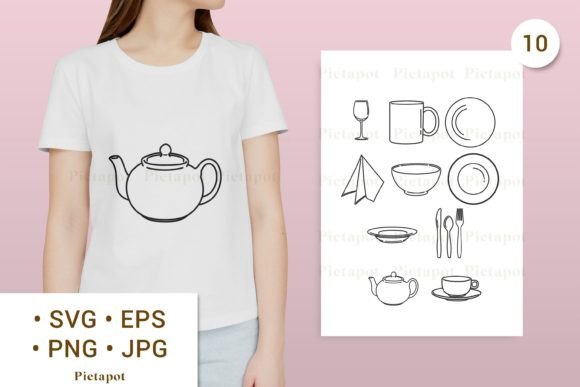
Dinner Cutlery Clipart Set of 10
A Designer’s First Look: Friendly, Functional, and Kitchen-Ready
When I opened the Dinner Cutlery Clipart Set of 10, my first thought wasn’t “cute” — it was “usable.” As someone who’s digitized hundreds of embroidery files for client projects, small-batch apparel, and Etsy shops, I scan for clarity, balance, and stitch-readiness before anything else. This set delivers a warm, approachable kitchen aesthetic — think clean-lined bowls, rounded plates, simple cups, flatware silhouettes, and one or two playful extras like a napkin ring or spoon rest. There’s no over-detailing, no fragile linework, and no visual clutter. That’s a win. It reads well at 3–4 inches wide — ideal for tote bags, tea towels, and baby bibs — and holds its shape even when scaled down to 2 inches for caps or patches.
Real Project Test: Embroidering a Linen Kitchen Towel for a Local Boutique
Last week, I used three pieces from the Dinner Cutlery Clipart Set of 10 — a plate, a cup, and a fork — on a natural linen towel destined for a downtown kitchen boutique. I stitched them in soft ecru thread on oat-colored fabric, using medium-weight cutaway stabilizer. The result? Crisp, confident, and quietly professional. The outlines held their shape without puckering; the fill areas stayed smooth and breathable (no dense, plasticky saturation). Customers noticed the stitching immediately — not because it shouted, but because it felt intentional and handmade. That’s the quiet strength of this set: it supports your brand voice instead of competing with it.
Where It Shines — And Where to Pause
The Dinner Cutlery Clipart Set of 10 works especially well for:
- Custom apparel: Sweatshirt chest logos, toddler onesie accents, apron pockets — the shapes are bold enough to read at arm’s length but gentle enough for everyday wear.
- Embroidered patch production: Clean edges and moderate detail mean fewer re-hooping stops and consistent satin-stitch coverage across batches.
- Holiday and wedding gifts: Think monogrammed napkin sets, embroidered oven mitts, or personalized baby blankets — it adds charm without overwhelming sentiment.
- Etsy listings and printable mockups: These illustrations translate cleanly into digital previews. Their balanced proportions make them easy to crop, layer, or pair with simple typography.
That said, proceed with care on:
- Stretchy fabrics like knits or ribbed terry — test stabilizer pairing thoroughly; loose weaves can distort fine curves in the cup handles or bowl rims.
- Dark or textured fabrics — the minimal line weight means contrast matters. A light thread on black denim may fade visually unless you boost stitch density slightly or add a subtle underlay.
- Curved surfaces like baseball caps — avoid placing the most intricate piece (e.g., a detailed spoon) directly over the front crown seam unless you’re confident in your hooping technique.
- Tiny hoop sizes under 3 inches — some elements shrink gracefully, but the napkin ring and layered flatware benefit from breathing room.
What It Adds to Your Finished Product — Beyond Stitch Count
Using the Dinner Cutlery Clipart Set of 10 doesn’t just fill space — it signals care. When customers see these designs on a handmade tea towel or a custom baby onesie, they register intention: “This wasn’t slapped on. Someone chose this.” That builds trust. For craft businesses and Etsy sellers, that perceived value lifts pricing confidence — you’re not selling thread and fabric, you’re selling warmth, utility, and thoughtful design. It also supports brand consistency: whether you’re launching a line of nursery kitchen gear or building a holiday collection for your small shop, this set provides cohesive, non-trendy illustration assets that won’t date quickly.
Practical Notes Every Embroidery Designer Should Check
Before committing to a full run — whether for personal use or commercial embroidery — do these five things:
- Test on scrap fabric that matches your final project’s weight and weave. Linen behaves differently than cotton poplin, which behaves differently than fleece.
- Review stitch density in your embroidery software. If fill areas look overly sparse or tightly packed, adjust underlay or density settings — don’t assume the file is optimized for your machine or fabric.
- Confirm licensing terms. Since this is listed as an Illustrations/Graphics product, verify whether it permits commercial use of finished embroidered items — especially if you plan to sell on Etsy, at craft fairs, or through wholesale channels.
- Check thread color contrast in both light and dark mockups. What reads beautifully on white fabric may disappear on charcoal — try a quick grayscale preview.
- Inspect small details like fork tines or cup stems at 200% zoom. Are they wide enough to stitch reliably? If not, consider simplifying or reinforcing with a running stitch outline.
Final Thought: A Quietly Versatile Workhorse
The Dinner Cutlery Clipart Set of 10 isn’t flashy — and that’s its superpower. In a market flooded with ornate, over-digitized graphics, it offers restraint, readability, and real-world adaptability. It’s the kind of design asset that disappears into your best work while making everything around it feel more considered. Whether you’re stitching a single gift or scaling up for a boutique launch, this set earns its place in your library of reliable design assets — not because it shouts, but because it shows up, clearly and kindly, every time.